 |
PIP 6.1.0
Platform-Independent Primitives
|
Loading...
Searching...
No Matches
|
PIP 6.1.0
Platform-Independent Primitives
|
Routes data between shared devices, packet extractors, channels and periodic senders. More...
#include <piconnection.h>
Public Member Functions | |
| PIConnection (const PIString &name=PIString::fromAscii("connection")) | |
| Constructs an empty connection with name "name". | |
| PIConnection (const PIString &config, const PIString &name) | |
| Constructs a connection and immediately configures it from section "name" of file "config". | |
| PIConnection (PIString *string, const PIString &name) | |
| Constructs a connection and immediately configures it from section "name" stored in "string". | |
| ~PIConnection () | |
| Releases all bindings owned by this connection. | |
| bool | configureFromConfig (const PIString &config, const PIString &name=PIString::fromAscii("connection")) |
| Reconfigures the connection from section "name" of file "config". | |
| bool | configureFromString (PIString *string, const PIString &name=PIString::fromAscii("connection")) |
| Reconfigures the connection from section "name" stored in "string". | |
| PIString | makeConfig () const |
| Serializes current connection state into one configuration section. | |
| PIIODevice * | addDevice (const PIString &full_path, PIIODevice::DeviceMode mode=PIIODevice::ReadWrite, bool start=false) |
| Adds device "full_path" to the shared device pool and binds it to this connection. | |
| void | setDeviceName (PIIODevice *dev, const PIString &name) |
| Assigns alias "name" to device "dev" inside this connection. | |
| PIStringList | deviceNames (const PIIODevice *dev) const |
| Returns all aliases assigned to device "dev" in this connection. | |
| bool | removeDevice (const PIString &full_path) |
| Unbinds device "full_path" from this connection. | |
| void | removeAllDevices () |
| Removes all devices currently bound to this connection. | |
| PIIODevice * | deviceByFullPath (const PIString &full_path) const |
| Returns bound device by normalized full path. | |
| PIIODevice * | deviceByName (const PIString &name) const |
| Returns bound device by alias. | |
| PIVector< PIIODevice * > | boundedDevices () const |
| Returns all devices currently bound to this connection. | |
| PIPacketExtractor * | addFilter (const PIString &name, const PIString &full_path_name, PIPacketExtractor::SplitMode mode=PIPacketExtractor::None) |
| Creates or reuses filter "name" and binds source "full_path_name" to it. | |
| PIPacketExtractor * | addFilter (const PIString &name, const PIIODevice *dev, PIPacketExtractor::SplitMode mode=PIPacketExtractor::None) |
| Creates or reuses filter "name" and binds device "dev" to it. | |
| PIPacketExtractor * | addFilter (PIPacketExtractor *filter, const PIString &full_path_name) |
| Binds existing extractor object "filter" to source "full_path_name". | |
| PIPacketExtractor * | addFilter (PIPacketExtractor *filter, const PIIODevice *dev) |
| Binds existing extractor object "filter" to device "dev". | |
| bool | removeFilter (const PIString &name, const PIString &full_path_name) |
| Unbinds source "full_path_name" from filter "name". | |
| bool | removeFilter (const PIString &name, const PIIODevice *dev) |
| Unbinds device or upstream filter "dev" from filter "name". | |
| bool | removeFilter (const PIString &name) |
| Removes filter "name" together with all its bindings. | |
| void | removeAllFilters () |
| Removes all filters from this connection. | |
| PIVector< PIPacketExtractor * > | filters () const |
| Returns all filters owned by this connection. | |
| PIStringList | filterNames () const |
| Returns names of all filters owned by this connection. | |
| PIPacketExtractor * | filter (const PIString &name) const |
Returns filter "name" or nullptr when it does not exist. | |
| PIVector< PIIODevice * > | filterBoundedDevices (const PIString &name) const |
| Returns all sources currently bound to filter "name". | |
| bool | addChannel (const PIString &name_from, const PIString &name_to) |
| Adds a routing channel from "name_from" to "name_to". | |
| bool | addChannel (const PIString &name_from, const PIIODevice *dev_to) |
| Adds a routing channel from "name_from" to device "dev_to". | |
| bool | addChannel (const PIIODevice *dev_from, const PIString &name_to) |
| Adds a routing channel from device "dev_from" to "name_to". | |
| bool | addChannel (const PIIODevice *dev_from, const PIIODevice *dev_to) |
| Adds a routing channel from device "dev_from" to device "dev_to". | |
| bool | removeChannel (const PIString &name_from, const PIString &name_to) |
| Removes routing channel from "name_from" to "name_to". | |
| bool | removeChannel (const PIString &name_from, const PIIODevice *dev_to) |
| Removes routing channel from "name_from" to device "dev_to". | |
| bool | removeChannel (const PIIODevice *dev_from, const PIString &name_to) |
| Removes routing channel from device "dev_from" to "name_to". | |
| bool | removeChannel (const PIIODevice *dev_from, const PIIODevice *dev_to) |
| Removes routing channel from device "dev_from" to device "dev_to". | |
| bool | removeChannel (const PIString &name_from) |
| Removes all outgoing channels starting from "name_from". | |
| bool | removeChannel (const PIIODevice *dev_from) |
| Removes all outgoing channels starting from device "dev_from". | |
| void | removeAllChannels () |
| Removes all routing channels from this connection. | |
| PIVector< PIPair< PIString, PIString > > | channels () const |
| Returns all routing channels as source and destination pairs. | |
| void | addSender (const PIString &name, const PIString &full_path_name, float frequency, bool start=false) |
| Creates or reuses sender "name" and binds device "full_path_name" to it. | |
| void | addSender (const PIString &name, const PIIODevice *dev, float frequency, bool start=false) |
| Creates or reuses sender "name" and binds device "dev" to it. | |
| bool | removeSender (const PIString &name, const PIString &full_path_name) |
| Unbinds device "full_path_name" from sender "name". | |
| bool | removeSender (const PIString &name, const PIIODevice *dev) |
| Unbinds device "dev" from sender "name". | |
| bool | removeSender (const PIString &name) |
| Removes sender "name" together with its timer state. | |
| bool | setSenderFixedData (const PIString &name, const PIByteArray &data) |
| Assigns fixed payload "data" to sender "name". | |
| bool | clearSenderFixedData (const PIString &name) |
| Clears fixed payload for sender "name". | |
| PIByteArray | senderFixedData (const PIString &name) const |
| Returns fixed payload configured for sender "name". | |
| float | senderFrequency (const PIString &name) const |
| Returns sender timer frequency. | |
| void | removeAllSenders () |
| Removes all senders from this connection. | |
| void | startThreadedRead (const PIString &full_path_name) |
| Starts threaded read for source "full_path_name". | |
| void | startThreadedRead (const PIIODevice *dev) |
| Starts threaded read for device "dev". | |
| void | startAllThreadedReads () |
| Starts threaded read for all devices bound to the shared pool. | |
| void | startSender (const PIString &name) |
| Starts sender timer "name". | |
| void | startAllSenders () |
| Starts all sender timers. | |
| void | start () |
| Starts all threaded reads and all senders. | |
| void | stopThreadedRead (const PIString &full_path_name) |
| Stops threaded read for source "full_path_name". | |
| void | stopThreadedRead (const PIIODevice *dev) |
| Stops threaded read for device "dev". | |
| void | stopAllThreadedReads () |
| Stops threaded read for all bound devices. | |
| void | stopSender (const PIString &name) |
| Stops sender timer "name". | |
| void | stopAllSenders () |
| Stops all sender timers. | |
| void | stop () |
| Stops all threaded reads and all senders. | |
| void | destroy () |
| Stops the connection and removes all bound devices. | |
| bool | isEmpty () const |
| Returns whether the connection currently has no bound devices. | |
| PIDiagnostics * | diagnostic (const PIString &full_path_name) const |
| Returns diagnostics object for device or filter "full_path_name". | |
| PIDiagnostics * | diagnostic (const PIIODevice *dev) const |
| Returns diagnostics object associated with device or filter "dev". | |
| int | writeByFullPath (const PIString &full_path, const PIByteArray &data) |
| Writes "data" to device resolved by full path "full_path". | |
| int | writeByName (const PIString &name, const PIByteArray &data) |
| Writes "data" to device resolved by alias "name". | |
| int | write (PIIODevice *dev, const PIByteArray &data) |
| Writes "data" directly to device "dev". | |
| Public Member Functions inherited from PIObject | |
| PIObject (const PIString &name=PIString()) | |
Constructs an object and initializes its name property. | |
| virtual | ~PIObject () |
| Destroys the object, raises deleted() and disconnects it from the event graph. | |
| PIString | name () const |
Returns the name property of this object. | |
| virtual const char * | className () const |
| Returns the registered class name of this object. | |
| virtual uint | classNameID () const |
| Returns the hash of className(). | |
| virtual const char * | parentClassName () const |
| Returns the registered parent class name, or an empty string for the root. | |
| bool | debug () const |
| Returns whether piCoutObj output is enabled for this object. | |
| void | setName (const PIString &name) |
Sets the name property of this object. | |
| void | setDebug (bool debug) |
| Enables or disables piCoutObj output for this object. | |
| PIVariant | property (const char *name) const |
| Returns the property with name "name". | |
| void | setProperty (const char *name, const PIVariant &value) |
| Sets the property "name" to "value" and creates it if needed. | |
| bool | isPropertyExists (const char *name) const |
| Returns whether the property "name" exists. | |
| void | setThreadSafe (bool yes) |
| Enables or disables the internal object mutex during handler execution. | |
| bool | isThreadSafe () const |
| Returns whether the internal object mutex is enabled for handler execution. | |
| bool | execute (const PIString &method, const PIVector< PIVariantSimple > &vl) |
| Executes a registered method or handler method by name with the supplied arguments. | |
| bool | execute (const PIString &method) |
| Overload of execute() for a method without arguments. | |
| bool | execute (const PIString &method, const PIVariantSimple &v0) |
| Overload of execute() for one argument. | |
| bool | execute (const PIString &method, const PIVariantSimple &v0, const PIVariantSimple &v1) |
| Overload of execute() for two arguments. | |
| bool | execute (const PIString &method, const PIVariantSimple &v0, const PIVariantSimple &v1, const PIVariantSimple &v2) |
| Overload of execute() for three arguments. | |
| bool | execute (const PIString &method, const PIVariantSimple &v0, const PIVariantSimple &v1, const PIVariantSimple &v2, const PIVariantSimple &v3) |
| Overload of execute() for four arguments. | |
| bool | executeQueued (PIObject *performer, const PIString &method, const PIVector< PIVariantSimple > &vl) |
| Queues execution of a registered method on the performer object. | |
| bool | executeQueued (PIObject *performer, const PIString &method) |
| Overload of executeQueued() for a method without arguments. | |
| bool | executeQueued (PIObject *performer, const PIString &method, const PIVariantSimple &v0) |
| Overload of executeQueued() for one argument. | |
| bool | executeQueued (PIObject *performer, const PIString &method, const PIVariantSimple &v0, const PIVariantSimple &v1) |
| Overload of executeQueued() for two arguments. | |
| bool | executeQueued (PIObject *performer, const PIString &method, const PIVariantSimple &v0, const PIVariantSimple &v1, const PIVariantSimple &v2) |
| Overload of executeQueued() for three arguments. | |
| bool | executeQueued (PIObject *performer, const PIString &method, const PIVariantSimple &v0, const PIVariantSimple &v1, const PIVariantSimple &v2, const PIVariantSimple &v3) |
| Overload of executeQueued() for four arguments. | |
| PIStringList | scopeList () const |
| Returns the registered inheritance scope of this object, including its own class. | |
| PIStringList | methodsEH () const |
| Returns full signatures of all registered event and handler methods for this class scope. | |
| bool | isMethodEHContains (const PIString &name) const |
| Returns whether a registered event or handler method with this name exists. | |
| PIString | methodEHArguments (const PIString &name) const |
| Returns the comma-separated argument type list of a registered method. | |
| PIString | methodEHFullFormat (const PIString &name) const |
| Returns the full registered signature of a method. | |
| PIString | methodEHFromAddr (const void *addr) const |
| Returns the registered method name for the specified entry-point address. | |
| void | piDisconnect (const PIString &sig, PIObject *dest, void *ev_h) |
| Disconnects this source object from a specific destination handler for event "sig". | |
| void | piDisconnect (const PIString &sig, PIObject *dest) |
| Disconnects this source object from all connections of event "sig" to destination object "dest". | |
| void | piDisconnect (const PIString &sig) |
| Disconnects this source object from all connections of event "sig". | |
| bool | isPIObject () const |
| Returns whether this pointer still refers to a live PIObject instance. | |
| template<typename T> | |
| bool | isTypeOf () const |
| Returns whether this object belongs to class "T" or one of its registered descendants. | |
| template<typename T> | |
| T * | cast () const |
Returns this object cast to "T" when isTypeOf<T>() succeeds, otherwise nullptr. | |
| void | callQueuedEvents () |
| Executes all queued deliveries posted to this performer object. | |
| bool | maybeCallQueuedEvents () |
| Executes queued deliveries only when this object was used as a performer. | |
| void | deleteLater () |
| Schedules the object for deferred deletion. | |
| void | deleted (PIObject *o) |
| Raised immediately before object destruction. | |
Static Public Member Functions | |
| static PIVector< PIConnection * > | allConnections () |
| Returns all currently alive PIConnection objects. | |
| static PIVector< PIIODevice * > | allDevices () |
| Returns all devices currently stored in the shared device pool. | |
| static bool | setFakeMode (bool yes) |
| Enables or disables shared device-pool fake mode and returns previous state. | |
| static bool | isFakeMode () |
| Returns whether the shared device pool works in fake mode. | |
| Static Public Member Functions inherited from PIObject | |
| static bool | execute (PIObject *o, const PIString &method, const PIVector< PIVariantSimple > &vl) |
| Static convenience wrapper for execute(). | |
| static bool | execute (PIObject *o, const PIString &method) |
| Static overload of execute() without arguments. | |
| static bool | execute (PIObject *o, const PIString &method, const PIVariantSimple &v0) |
| Static overload of execute() for one argument. | |
| static bool | execute (PIObject *o, const PIString &method, const PIVariantSimple &v0, const PIVariantSimple &v1) |
| Static overload of execute() for two arguments. | |
| static bool | execute (PIObject *o, const PIString &method, const PIVariantSimple &v0, const PIVariantSimple &v1, const PIVariantSimple &v2) |
| Static overload of execute() for three arguments. | |
| static bool | execute (PIObject *o, const PIString &method, const PIVariantSimple &v0, const PIVariantSimple &v1, const PIVariantSimple &v2, const PIVariantSimple &v3) |
| Static overload of execute() for four arguments. | |
| static bool | executeQueued (PIObject *o, PIObject *performer, const PIString &method, const PIVector< PIVariantSimple > &vl) |
| Static convenience wrapper for executeQueued(). | |
| static bool | executeQueued (PIObject *o, PIObject *performer, const PIString &method) |
| Static overload of executeQueued() without arguments. | |
| static bool | executeQueued (PIObject *o, PIObject *performer, const PIString &method, const PIVariantSimple &v0) |
| Static overload of executeQueued() for one argument. | |
| static bool | executeQueued (PIObject *o, PIObject *performer, const PIString &method, const PIVariantSimple &v0, const PIVariantSimple &v1) |
| Static overload of executeQueued() for two arguments. | |
| static bool | executeQueued (PIObject *o, PIObject *performer, const PIString &method, const PIVariantSimple &v0, const PIVariantSimple &v1, const PIVariantSimple &v2) |
| Static overload of executeQueued() for three arguments. | |
| static bool | executeQueued (PIObject *o, PIObject *performer, const PIString &method, const PIVariantSimple &v0, const PIVariantSimple &v1, const PIVariantSimple &v2, const PIVariantSimple &v3) |
| Static overload of executeQueued() for four arguments. | |
| static PIObject::Connection | piConnect (PIObject *src, const PIString &sig, PIObject *dest_o, void *dest, void *ev_h, void *e_h, int args, const char *loc) |
Low-level direct connection helper behind the legacy CONNECT* macros. | |
| static PIObject::Connection | piConnectU (PIObject *src, const PIString &sig, PIObject *dest_o, void *dest, const PIString &hname, const char *loc, PIObject *performer=0) |
| Low-level name-based connection helper behind CONNECTU() and CONNECTU_QUEUED(). | |
| static PIObject::Connection | piConnectLS (PIObject *src, const PIString &sig, std::function< void()> *f, const char *loc) |
| Low-level helper that connects an event to a lambda or functor wrapper. | |
| static void | piDisconnect (PIObject *src, const PIString &sig, PIObject *dest, void *ev_h) |
| Disconnects source object "src" from a specific destination handler for event "sig". | |
| static void | piDisconnect (PIObject *src, const PIString &sig, PIObject *dest) |
| Disconnects source object "src" from all connections of event "sig" to destination object "dest". | |
| static void | piDisconnect (PIObject *src, const PIString &sig) |
| Disconnects source object "src" from all connections of event "sig". | |
| static void | raiseEvent (PIObject *sender, const uint eventID) |
| Internal event delivery helper for registered events without arguments. | |
| template<typename T0> | |
| static void | raiseEvent (PIObject *sender, const uint eventID, const T0 &v0=T0()) |
| Internal event delivery helper for registered events with one argument. | |
| template<typename T0, typename T1> | |
| static void | raiseEvent (PIObject *sender, const uint eventID, const T0 &v0=T0(), const T1 &v1=T1()) |
| Internal event delivery helper for registered events with two arguments. | |
| template<typename T0, typename T1, typename T2> | |
| static void | raiseEvent (PIObject *sender, const uint eventID, const T0 &v0=T0(), const T1 &v1=T1(), const T2 &v2=T2()) |
| Internal event delivery helper for registered events with three arguments. | |
| template<typename T0, typename T1, typename T2, typename T3> | |
| static void | raiseEvent (PIObject *sender, const uint eventID, const T0 &v0=T0(), const T1 &v1=T1(), const T2 &v2=T2(), const T3 &v3=T3()) |
| Internal event delivery helper for registered events with four arguments. | |
| static PIObject * | findByName (const PIString &name) |
Returns the first live object with name "name", or nullptr. | |
| static bool | isPIObject (const PIObject *o) |
| Returns whether "o" points to a live PIObject instance. | |
| static bool | isPIObject (const void *o) |
| Overload of isPIObject() for an untyped pointer. | |
| template<typename T> | |
| static bool | isTypeOf (const PIObject *o) |
| Returns whether "o" belongs to class "T" or one of its registered descendants. | |
| template<typename T> | |
| static bool | isTypeOf (const void *o) |
| Overload of isTypeOf() for an untyped pointer. | |
| static PIString | simplifyType (const char *a, bool readable=true) |
| Simplifies a C++ type spelling for registered-method metadata. | |
Protected Member Functions | |
| virtual void | dataReceived (const PIString &from, const PIByteArray &data) |
| Called after raw data is received from source "from". | |
| virtual void | packetReceived (const PIString &from, const PIByteArray &data) |
| Called after filter "from" produces a packet. | |
| virtual PIByteArray | senderData (const PIString &sender_name) |
| Returns dynamic payload for sender "sender_name". | |
| Protected Member Functions inherited from PIObject | |
| PIObject * | emitter () const |
| Returns the source object that raised the current event. | |
| virtual void | propertyChanged (const char *name) |
| Virtual method called after property "name" has been changed by setProperty(). | |
Events | |
| void | dataReceivedEvent (const PIString &from, const PIByteArray &data) |
| Emitted when raw data is received from source "from". | |
| void | packetReceivedEvent (const PIString &from, const PIByteArray &data) |
| Emitted when filter "from" produces a packet. | |
| void | qualityChanged (const PIIODevice *dev, PIDiagnostics::Quality new_quality, PIDiagnostics::Quality old_quality) |
| Emitted when diagnostics quality of "device" changes. | |
Additional Inherited Members | |
| Related Symbols inherited from PIObject | |
| #define | piCoutObj |
| Macro used for conditional (piDebug && PIObject::debug()) output to PICout(StdOut) for subclasses of PIObject. | |
| #define | piCerrObj |
| Macro used for conditional (piDebug && PIObject::debug()) output to PICout(StdErr) for subclasses of PIObject. | |
| #define | PIOBJECT(name) |
| Put this macro inside a direct PIObject subclass definition to enable registered events, event handlers and class metadata. | |
| #define | PIOBJECT_SUBCLASS(name, parent) |
| Put this macro inside a PIObject subclass definition to inherit registered methods and class scope from "parent". | |
| #define | EVENT_HANDLER0(ret, name) |
| Declare a registered event handler method with signature ret name(). | |
| #define | EVENT_HANDLER1(ret, name, type0, var0) |
| Declare a registered event handler method with one argument. | |
| #define | EVENT_HANDLER2(ret, name, type0, var0, type1, var1) |
| Declare a registered event handler method with two arguments. | |
| #define | EVENT_HANDLER3(ret, name, type0, var0, type1, var1, type2, var2) |
| Declare a registered event handler method with three arguments. | |
| #define | EVENT_HANDLER4(ret, name, type0, var0, type1, var1, type2, var2, type3, var3) |
| Declare a registered event handler method with four arguments. | |
| #define | EVENT_HANDLER EVENT_HANDLER0 |
| Synonym of EVENT_HANDLER0. | |
| #define | EVENT_VHANDLER0(ret, name) |
| Declare a virtual registered event handler method with signature virtual ret name(). | |
| #define | EVENT_VHANDLER1(ret, name, type0, var0) |
| Declare a virtual registered event handler method with one argument. | |
| #define | EVENT_VHANDLER2(ret, name, type0, var0, type1, var1) |
| Declare a virtual registered event handler method with two arguments. | |
| #define | EVENT_VHANDLER3(ret, name, type0, var0, type1, var1, type2, var2) |
| Declare a virtual registered event handler method with three arguments. | |
| #define | EVENT_VHANDLER4(ret, name, type0, var0, type1, var1, type2, var2, type3, var3) |
| Declare a virtual registered event handler method with four arguments. | |
| #define | EVENT_VHANDLER EVENT_VHANDLER0 |
| Synonym of EVENT_VHANDLER0. | |
| #define | EVENT0(name) |
| Declare an event method with no arguments. | |
| #define | EVENT1(name, type0, var0) |
| Declare an event method with one argument. | |
| #define | EVENT2(name, type0, var0, type1, var1) |
| Declare an event method with two arguments. | |
| #define | EVENT3(name, type0, var0, type1, var1, type2, var2) |
| Declare an event method with three arguments. | |
| #define | EVENT4(name, type0, var0, type1, var1, type2, var2, type3, var3) |
| Declare an event method with four arguments. | |
| #define | EVENT EVENT0 |
| Synonym of EVENT0. | |
| #define | RAISE_EVENT0(src, event) |
| Compatibility helper that raises event "event" on source object "src". | |
| #define | RAISE_EVENT1(src, event, v0) |
| Compatibility helper that raises event "event" with one argument. | |
| #define | RAISE_EVENT2(src, event, v0, v1) |
| Compatibility helper that raises event "event" with two arguments. | |
| #define | RAISE_EVENT3(src, event, v0, v1, v2) |
| Compatibility helper that raises event "event" with three arguments. | |
| #define | RAISE_EVENT4(src, event, v0, v1, v2, v3) |
| Compatibility helper that raises event "event" with four arguments. | |
| #define | CONNECTU(src, event, dest, handler) |
| Connect event "event" from object "src" to event handler or event "handler" of object "dest". | |
| #define | CONNECTU_QUEUED(src, event, dest, handler, performer) |
| Connect event "event" from object "src" to event handler or event "handler" of object "dest". | |
| #define | CONNECTL(src, event, functor) |
| Connect event "event" from object "src" to lambda-expression "functor". | |
| #define | CONNECT0(ret, src, event, dest, handler) |
| Legacy compatibility helper that connects an event to a registered handler with compile-time signature spelling. | |
| #define | CONNECT1(ret, type0, src, event, dest, handler) |
| Legacy compatibility helper for a one-argument registered event or handler. | |
| #define | CONNECT2(ret, type0, type1, src, event, dest, handler) |
| Legacy compatibility helper for a two-argument registered event or handler. | |
| #define | CONNECT3(ret, type0, type1, type2, src, event, dest, handler) |
| Legacy compatibility helper for a three-argument registered event or handler. | |
| #define | CONNECT4(ret, type0, type1, type2, type3, src, event, dest, handler) |
| Legacy compatibility helper for a four-argument registered event or handler. | |
| #define | CONNECT CONNECT0 |
| Synonym of CONNECT0. | |
| #define | WEAK_CONNECT0(ret, src, event, dest, handler) |
| Legacy compatibility helper that skips source method verification. | |
| #define | WEAK_CONNECT1(ret, type0, src, event, dest, handler) |
| Legacy compatibility helper that skips source method verification for one argument. | |
| #define | WEAK_CONNECT2(ret, type0, type1, src, event, dest, handler) |
| Legacy compatibility helper that skips source method verification for two arguments. | |
| #define | WEAK_CONNECT3(ret, type0, type1, type2, src, event, dest, handler) |
| Legacy compatibility helper that skips source method verification for three arguments. | |
| #define | WEAK_CONNECT4(ret, type0, type1, type2, type3, src, event, dest, handler) |
| Legacy compatibility helper that skips source method verification for four arguments. | |
| #define | WEAK_CONNECT WEAK_CONNECT0 |
| Synonym of WEAK_CONNECT0. | |
| #define | DISCONNECT0(ret, src, event, dest, handler) |
| Disconnect a registered event from a registered event handler. | |
| #define | DISCONNECT1(ret, type0, src, event, dest, handler) |
| Disconnect a one-argument registered event from a registered event handler. | |
| #define | DISCONNECT2(ret, type0, type1, src, event, dest, handler) |
| Disconnect a two-argument registered event from a registered event handler. | |
| #define | DISCONNECT3(ret, type0, type1, type2, src, event, dest, handler) |
| Disconnect a three-argument registered event from a registered event handler. | |
| #define | DISCONNECT4(ret, type0, type1, type2, type3, src, event, dest, handler) |
| Disconnect a four-argument registered event from a registered event handler. | |
| #define | DISCONNECT DISCONNECT0 |
| Synonym of DISCONNECT0. | |
| #define | HANDLER(handler) |
| Low-level helper that expands to the registered handler entry point. | |
Routes data between shared devices, packet extractors, channels and periodic senders.
Complex Input/Output point.
PIConnection uses a process-wide device pool so several connections can share the same physical device. Raw device data may be forwarded into named filters, routed through channels, monitored with diagnostics and emitted by periodic senders.
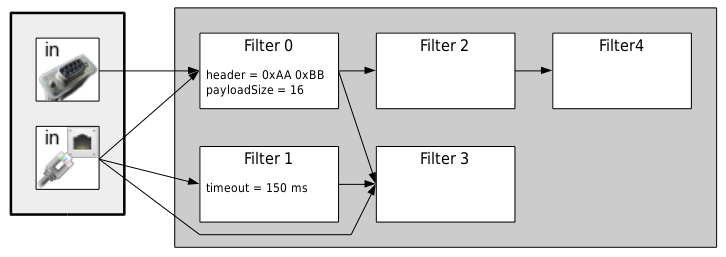
PIConnection provides abstract layer over physical devices, filtering and connecting data streams. Each PIConnection works through Device Pool, so several PIConnections can read from single physical device. General scheme:

Device pool is static object, single for each application, which contains unique devices. Each PIConnection works with real devices through Device pool. Each device has assosiated thread for read and it can be started or stopped with PIConnection functions startThreadedRead() and stopThreadedRead().
PIConnection filter is a PIPacketExtractor and assosiated array of devices or other filters. When read thread is successfully read from device this data can be passed to one or more filters. Each filter has name and filter names should be unique. You can use this name for access to PIPacketExtractor* with function filter(), or get array of assosiated devices and filters with function filterBoundedDevices(). One filter can receive data from several sources, and can be bounded to several filters.
PIConnection create PIDiagnostics for each device or filter. You can access to these objects with functions diagnostic().
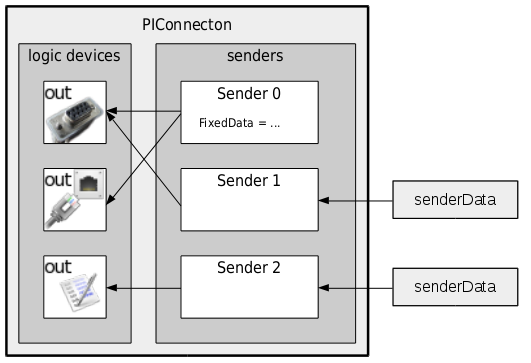
PIConnection can send data to devices with named timers ("senders"). You can create sender or add device to sender with function addSender(). Each sender has internal timer and every tick execute virtual function senderData(). Returns value of this function sended to bounded devices. You can assign fixed send data to sender with function setSenderFixedData(). In this case sender will NOT execute senderData(), but send assigned data.
You can create PIConnection from config file section or configure it later with function configureFromConfig(). Devices describes with its full pathes, for details see Creating devices by unambiguous string. Example:

Also PIConnection can create PIString with its configuration with function makeConfig(). This string can be directly inserted into the config file.
| bool PIConnection::configureFromConfig | ( | const PIString & | config, |
| const PIString & | name = PIString::fromAscii ("connection") ) |
Reconfigures the connection from section "name" of file "config".
Warning: all devices, filters and channels removed before configure!
| bool PIConnection::configureFromString | ( | PIString * | string, |
| const PIString & | name = PIString::fromAscii ("connection") ) |
Reconfigures the connection from section "name" stored in "string".
Warning: all devices, filters and channels removed before configure!
| PIIODevice * PIConnection::addDevice | ( | const PIString & | full_path, |
| PIIODevice::DeviceMode | mode = PIIODevice::ReadWrite, | ||
| bool | start = false ) |
Adds device "full_path" to the shared device pool and binds it to this connection.
Returns the shared device instance or nullptr when creation fails. When "start" is true, threaded read starts immediately.
| bool PIConnection::removeDevice | ( | const PIString & | full_path | ) |
Unbinds device "full_path" from this connection.
The shared device object is deleted from the pool only when no connections still use it.
| void PIConnection::removeAllDevices | ( | ) |
Removes all devices currently bound to this connection.
Devices remain in the shared pool while they are still referenced by other connections.
| PIPacketExtractor * PIConnection::addFilter | ( | const PIString & | name, |
| const PIString & | full_path_name, | ||
| PIPacketExtractor::SplitMode | mode = PIPacketExtractor::None ) |
Creates or reuses filter "name" and binds source "full_path_name" to it.
If there is no filter with name "name", connection create new with split mode "mode" and bound to it device "full_path_name" or filter "full_path_name". If filter with name "name" already exists, device "full_path_name" or filter "full_path_name" add to this filter. This function returns PIPacketExtractor * assosiated with this filter.
Unbinds source "full_path_name" from filter "name".
Removes the filter itself when it no longer has any bound sources.
Adds a routing channel from "name_from" to "name_to".
Both endpoints may reference a device full path, a device alias or a filter name.
| void PIConnection::addSender | ( | const PIString & | name, |
| const PIString & | full_path_name, | ||
| float | frequency, | ||
| bool | start = false ) |
Creates or reuses sender "name" and binds device "full_path_name" to it.
If there is no sender with name "name", connection create new, bound to it device "full_path_name" and start sender timer with frequency "frequency". If sender with name "name" already exists, device "full_path_name" add to this sender If "start" is true, sender is started immediately. Else, you can start sender with functions startSender().
Unbinds device "full_path_name" from sender "name".
If there is no devices bounded to this sender, it will be removed. Returns if sender was removed.
| float PIConnection::senderFrequency | ( | const PIString & | name | ) | const |
Returns sender timer frequency.
Returns -1 when the sender does not exist and 0 when it exists but is not running.
 1.18.0